
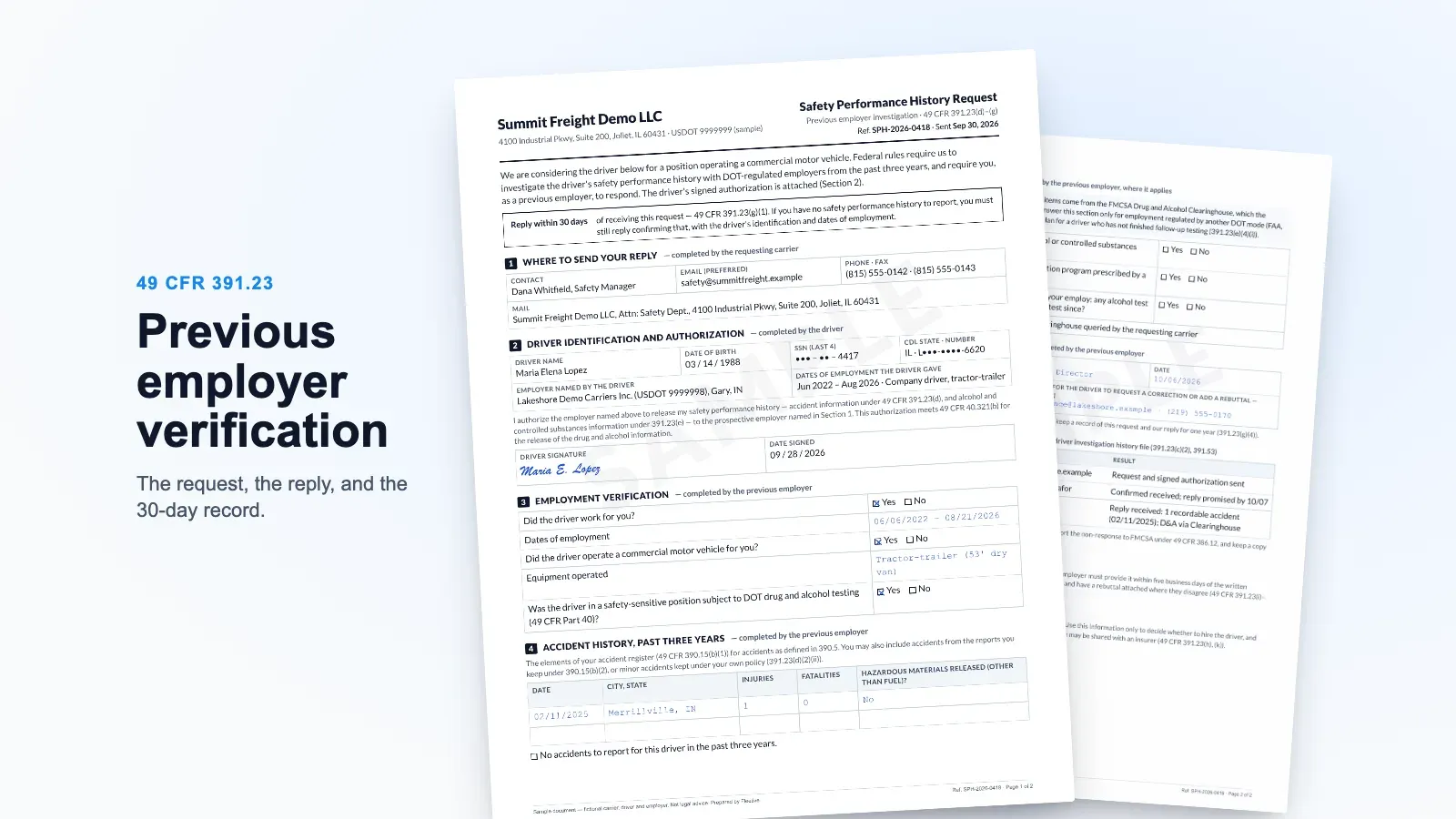
Short answer: before — or within 30 days after — a new driver starts, you must investigate their safety performance history with every DOT-regulated employer they worked for in the past three years (49 CFR 391.23). You ask for employment verification and accident history from each one, you check drug and alcohol history (through the Clearinghouse for FMCSA employers), and you keep a written record of every contact. Within 30 days of the driver’s start date, the replies — or documented good-faith efforts to get them — must be in the driver’s investigation history file.
Carriers also call this DOT employment verification, or a safety performance history request. This guide walks through it in the order you actually do it, with a filled-in sample request you can compare yours against.
General information, not legal advice. The regulation text quoted here is current as of October 2026. Check the eCFR link above before relying on a specific paragraph.
The 30-day rule most people get wrong
You will read that “you have 30 days to start the investigation.” That is not what the rule says. 391.23(c)(1) says the replies to the investigation, or documentation of good-faith efforts to obtain them, must be placed in the driver investigation history file within 30 days of the date the driver’s employment begins.
Two practical consequences:
- Send requests the day you get the signed application, not the day the driver starts. Previous employers have 30 days to answer you (391.23(g)(1)). If you wait until the start date, your 30 days and theirs run at the same time, and a slow employer leaves you documenting good faith instead of filing a reply.
- A missing reply is not a violation. A missing record is. If you made real attempts and wrote them down, you have the record 391.23(c) asks for. If you made one phone call and wrote nothing down, you have not.
The time a driver spends reviewing, correcting or rebutting what an employer sent is “separate and apart” from this 30-day window (391.23(c)(1)).
Who you have to ask
Look at the employment history on the driver’s application — 391.21(b)(10) asks for the past three years of employers — and pick out every DOT-regulated employer in that window. Then split them two ways:
| Previous employer | What you must investigate | How |
|---|---|---|
| Employed the driver to operate a CMV in the past 3 years | Employment verification + accident history — 391.23(d) | Request directly to the employer |
| Employed the driver in a safety-sensitive, DOT-tested position, FMCSA-regulated | Drug and alcohol history — 391.23(e) | FMCSA Drug and Alcohol Clearinghouse (391.23(e)(4)) |
| Same, but regulated by another DOT mode (FAA, FRA, FTA, PHMSA, USCG) | Drug and alcohol history — 391.23(e) | Request directly to the employer (391.23(e)(4)(ii)) |
| Driver has no DOT-regulated employment in the past 3 years | Nothing to investigate | Document that no investigation was possible (391.23(c)(4)) |
Non-DOT jobs — warehouse work, a non-CMV driving job — are not part of this investigation. The application still lists them; the safety performance history request does not go to them.
What to ask each previous employer
391.23(d) sets the minimum you must ask for:
- General driver identification and employment verification — did this person work for you, when, and did they drive a CMV.
- Accidents in the past three years — the data elements of the employer’s accident register under 49 CFR 390.15(b)(1) for accidents as defined in 390.5: the date, the city or town and state, the driver’s name, the number of injuries, the number of fatalities, and whether hazardous materials other than spilled fuel were released. The employer may also add accidents from the reports it keeps under 390.15(b)(2), or minor accidents it keeps under its own policy.
And, where it applies, 391.23(e) adds the drug and alcohol questions: any violation of the alcohol and controlled substances prohibitions in the past three years; any failure to start or finish a rehabilitation program prescribed by a substance abuse professional (SAP); and, for a driver who finished a SAP referral and stayed with that employer, any later alcohol test at 0.04 or higher, verified positive drug test, or refusal to test.
Your request must say where to send the answer — “specific contact information on where the previous motor carrier employers should send the information requested” (391.23(d)). A request that only names your company is a request that comes back late or not at all.
Step by step
1. Collect consent and give the rights notice in the application
Before any hiring decision, a driver with DOT-regulated employment in the past three years must be told — on the application or another written document — that they have the right to review what previous employers send, to have errors corrected, and to have a rebuttal attached (391.23(i)(1)). Before the application is submitted, you must also tell applicants that the employers they list may be contacted for this investigation (391.21(d)).
For the drug and alcohol part you need the driver’s written consent, meeting 49 CFR 40.321(b), to release that information to you (391.23(f)(1)). A driver who refuses that consent — or refuses consent for the Clearinghouse query — may not operate a CMV for you (391.23(f)(1)–(2)).
2. Run the Clearinghouse query before the driver works
For FMCSA-regulated prior employment, the drug and alcohol check is the Clearinghouse pre-employment full query. Unlike the rest of this investigation, it has to happen before the driver performs a safety-sensitive function (49 CFR 382.701(a)), and the driver has to give specific consent in the Clearinghouse.
Two cases still need a direct request: a driver who has not finished follow-up testing (you request the follow-up testing plan from the previous employer, 391.23(e)(4)(i)), and prior employment under a DOT mode other than FMCSA (391.23(e)(4)(ii)).
3. Send a safety performance history request to each previous employer
Use any method that “reasonably ensures confidentiality” — letter, fax or email (391.23(h)). FMCSA publishes a two-part Safety Performance History Records Request form; many carriers use it or their own version. Whatever you use, include:
- your contact details, prominently, for the reply;
- the driver’s identifying details and the dates of employment the driver gave you;
- the driver’s signed consent for the drug and alcohol information (391.23(f)(1) requires it for that part; most carriers attach one authorization covering the whole request);
- the accident questions from 391.23(d), and the drug and alcohol questions from 391.23(e) where they apply.
Here is a filled-in sample, so you can see what a complete request and reply look like:
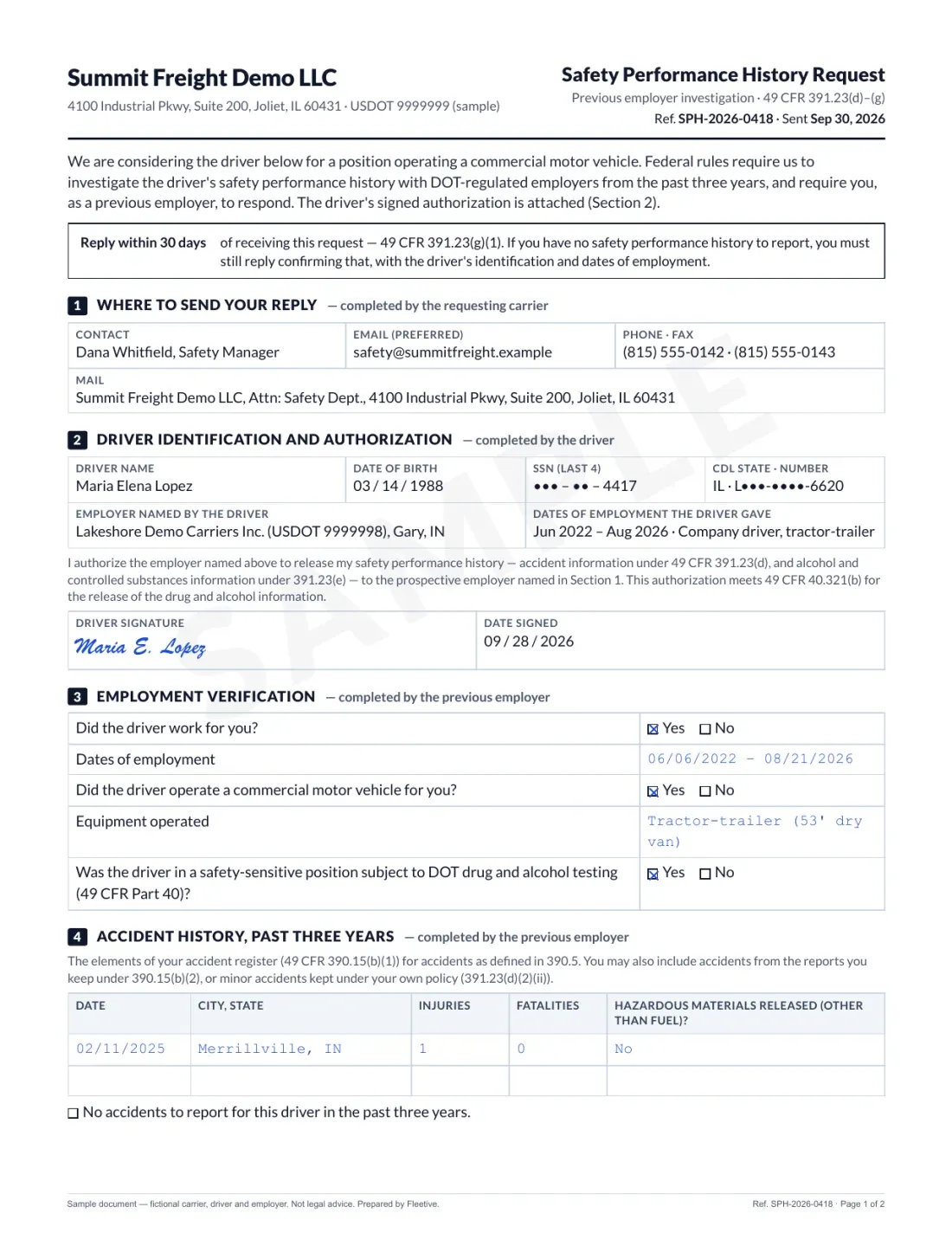
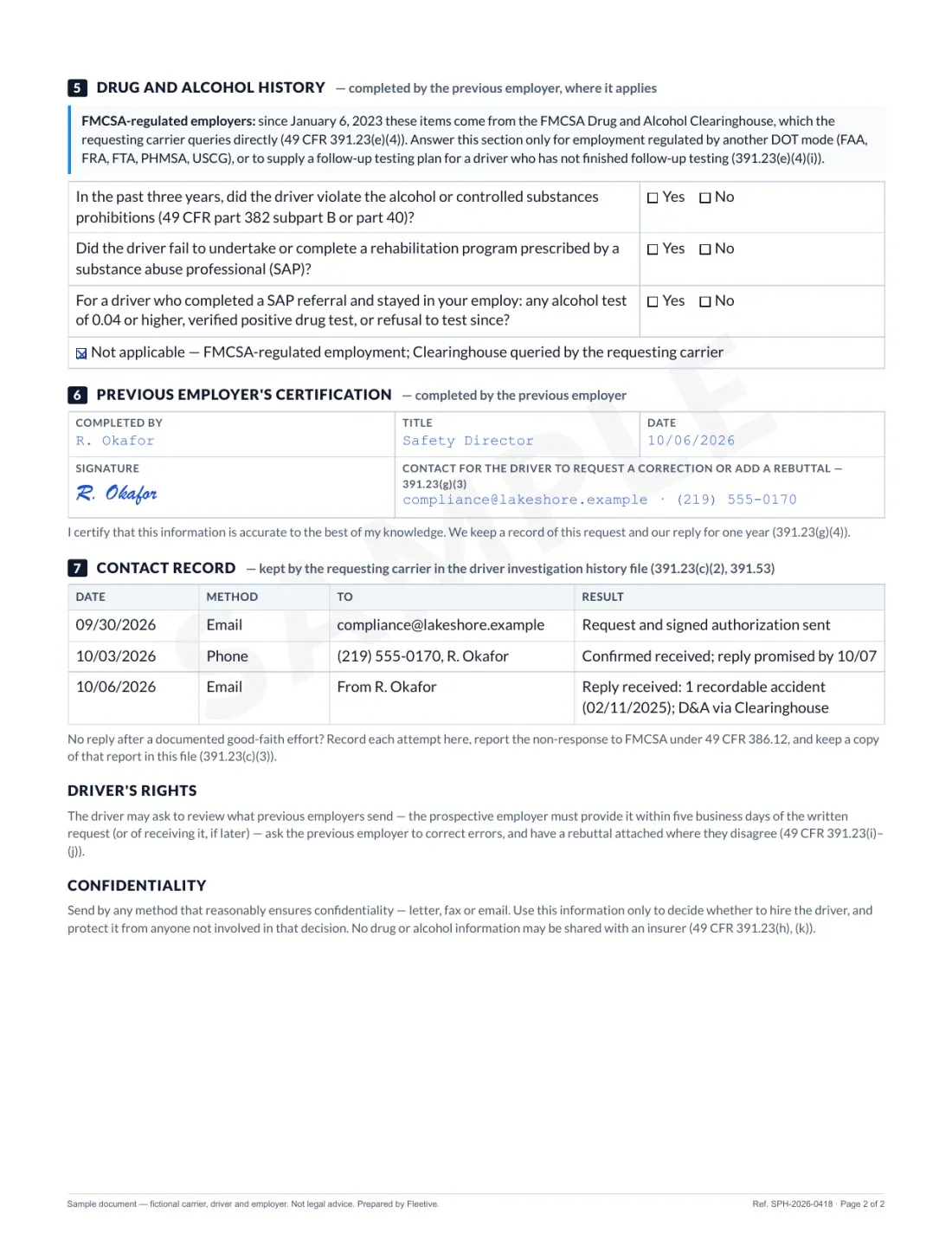
Sample only — the carrier, driver and employer are fictional. Not legal advice.
4. Follow up, and write down every attempt
391.23(c)(2) is specific about the record you must keep for each previous employer: the employer’s name and address, the date you contacted them or the attempts you made, and the information you received. A short contact log — date, method, who, result — satisfies it, and it is the first thing an auditor asks for when a reply is missing.
A reasonable cadence: send on day 0; call on day 7 if nothing has arrived; send a second written request around day 14; and decide by day 25 whether you are filing a reply or a good-faith record.
5. If an employer never answers
Keep the log of every attempt. 391.23(c)(3) says you should report the previous employer’s failure to respond to FMCSA, using the complaint procedures in 49 CFR 386.12, and keep a copy of that report in the file as part of your good-faith effort. Previous employers are required to answer within 30 days — even when there is nothing to report (391.23(g)(1)).
6. File it in the driver investigation history file — not the DQF
Replies, the driver’s drug and alcohol authorization, and your good-faith documentation go in the driver investigation history file under 49 CFR 391.53. It is a different file from the driver qualification file, and the rules for it are stricter:
- kept in a secure location with controlled access, limited to people involved in the hiring decision or who control access to the data;
- used only for the hiring decision (391.23(k)(1));
- your insurer may see it — except the drug and alcohol information (391.53(a)(1));
- for a driver you hire, retained for as long as they are employed and three years after (391.53(c)).
If you keep everything in one folder, an auditor will notice — and so might a manager who should never have seen a former employer’s drug and alcohol answers. The DQF checklist covers what does belong in the DQF.
7. If the driver asks to see it
A driver with DOT-regulated employment in the past three years can make a written request to review what previous employers sent — when applying, or as late as 30 days after being hired or turned down. You must provide it within five business days of the request, or of receiving the information if it had not arrived yet (391.23(i)(2)). If the driver does not arrange to pick it up within 30 days of you making it available, you may treat the request as waived.
Corrections and rebuttals go to the previous employer, not to you (391.23(j)). The previous employer has 15 days to correct the record or tell the driver it will not, and five business days to forward a rebuttal to you.
What previous employers have to do
If you are on the other side — a carrier that receives these requests — 391.23(g) applies to you:
- respond within 30 days of receiving the request, including when there is nothing to report;
- take reasonable precautions to make sure the records are accurate;
- provide specific contact information in case the driver wants to ask you for a correction or add a rebuttal;
- keep a record of each request and your response for one year — the date, who it went to, and a summary of what you provided.
Answering in good faith and following the procedures carries a legal protection: no action for defamation, invasion of privacy or interference with a contract can be based on furnishing or using the information in accordance with 391.23. That protection does not cover someone who knowingly furnishes false information, or who did not follow the procedures, and insurers get no limit on liability for alcohol and controlled substances information (391.23(l)).
Common mistakes
- Sending requests on the start date. Send them when the application is signed.
- Asking the wrong employers. The 391.23(d) accident questions go to employers the driver drove a CMV for; the 391.23(e) drug and alcohol questions go to safety-sensitive, DOT-tested employers. Non-DOT jobs are out of scope.
- No contact information on the request. 391.23(d) requires it.
- Calling and not writing it down. A phone call you cannot show is a phone call that did not happen.
- Filing replies in the DQF. They belong in the investigation history file, with restricted access.
- Sharing drug and alcohol answers with your insurer. 391.23(k)(2) and 391.53(a)(1) forbid it.
- Using the information for anything but hiring — performance reviews, discipline, pay. 391.23(k)(1) limits it to the hiring decision.
- Forgetting drivers with no prior DOT employment. You still file a note that no investigation was possible (391.23(c)(4)).
How Fleetive helps
Fleetive does not send requests to previous employers for you. It handles the parts around them:
- When a driver completes the employment application in Fleetive, it collects the three years of employer history this investigation starts from.
- Previous Employer Verification is a required record for every driver, and Fleetive raises an alert when it hasn’t been filed, so a driver whose replies never came in does not slip through.
Pair it with a PSP report — voluntary, but it shows the crash and inspection history a previous employer may not mention.
Frequently asked questions
Do I have to wait for previous employers to reply before a new driver can drive?
The previous-employer investigation rules in 391.23 do not make you wait. It requires the replies, or documentation of your good-faith efforts to get them, to be in the driver investigation history file within 30 days of the date the driver’s employment begins. Two related steps do come first: the pre-employment Clearinghouse full query (49 CFR 382.701(a)) must be done before the driver performs a safety-sensitive function, and a driver who refuses the drug and alcohol consent in 391.23(f) may not operate a commercial motor vehicle for you.
How many years back does a previous employer verification go?
Three years. You must investigate the driver’s safety performance history with every DOT-regulated employer the driver worked for in the three years before the application — the accident information in 391.23(d) from employers the driver drove a CMV for, and the drug and alcohol information in 391.23(e) from employers where the driver was in a safety-sensitive, DOT-tested position.
What if a previous employer never responds?
Document every attempt — who you contacted, how, when, and what happened — and put that record in the driver investigation history file within the 30 days. 391.23(c)(3) says you should report the employer’s failure to respond to FMCSA under the complaint procedures in 49 CFR 386.12, and keep a copy of that report in the file as part of your good-faith effort.
How long does a previous employer have to answer?
30 days after receiving the request (49 CFR 391.23(g)(1)). If there is nothing to report, the previous employer still has to respond, confirming that no safety performance history exists and giving the driver’s identification and dates of employment.
Do I still ask previous employers about drug and alcohol violations?
For FMCSA-regulated previous employers, the drug and alcohol part of the check is done through the FMCSA Drug and Alcohol Clearinghouse (391.23(e)(4), since January 6, 2023). You still ask previous employers directly when the driver’s prior employment was regulated by another DOT mode, and when you need the follow-up testing plan for a driver who has not finished follow-up testing.
Where do the replies go — the driver qualification file?
No. Replies and good-faith documentation go in the driver investigation history file under 49 CFR 391.53, which is separate from the driver qualification file, kept in a secure location with controlled access, and used only for the hiring decision. For a driver you hire, keep it for as long as they work for you plus three years.
Can the driver see what a previous employer said about them?
Yes. A driver with DOT-regulated employment in the past three years can make a written request to review it — at any time, including when applying, or as late as 30 days after being hired or turned down — and you must provide it within five business days (391.23(i)). The driver can ask the previous employer to correct errors, or to attach a rebuttal (391.23(j)).
Note: This article is for general informational purposes and reflects regulations as of its publish date. It is not legal advice. Always confirm current requirements with the FMCSA and the eCFR, or your compliance counsel.
We help carriers turn DOT compliance from a scramble into a system. See how Fleetive works →