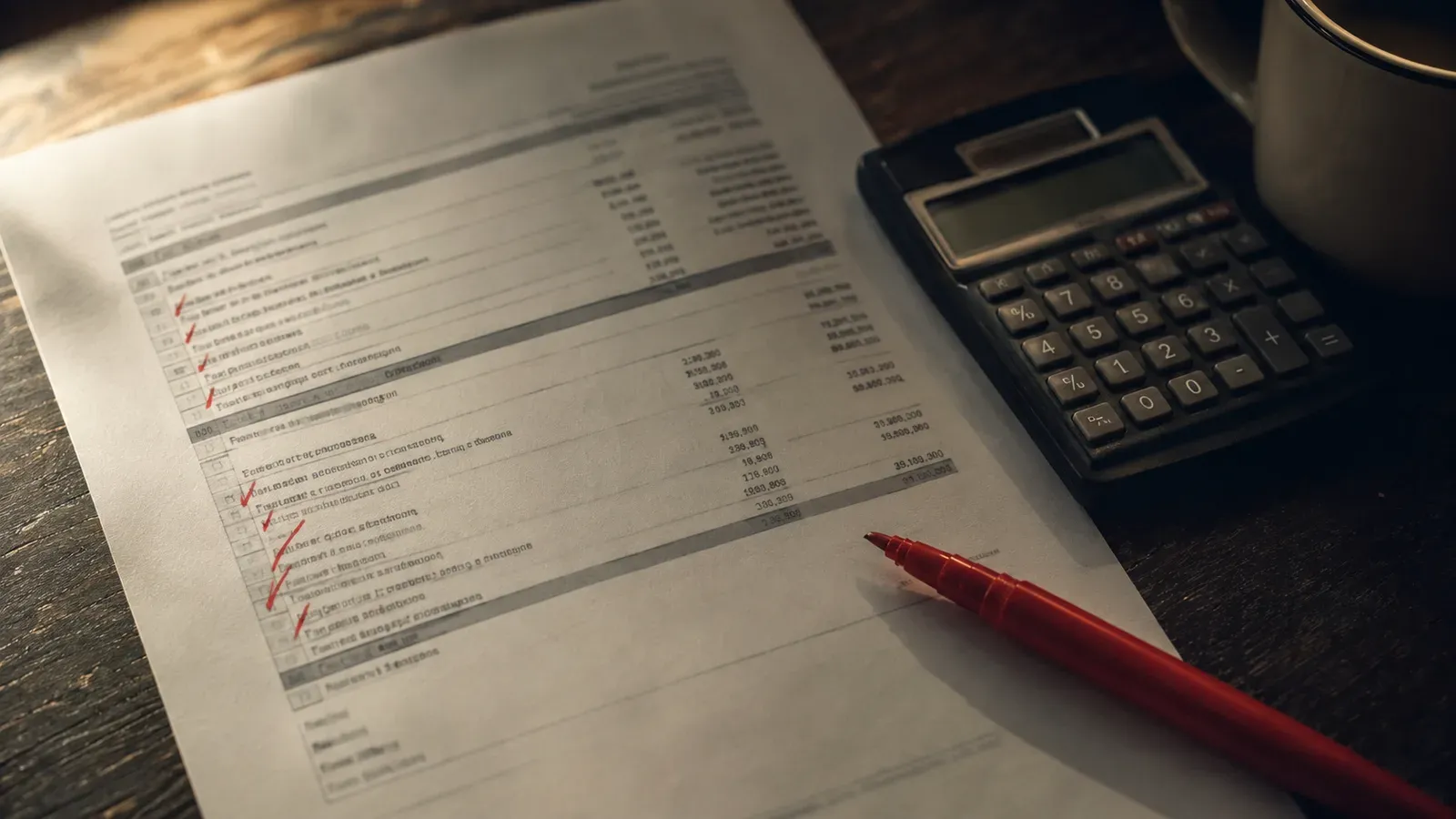

If you are a leased owner-operator, the carrier cannot hold your final settlement indefinitely — 49 CFR 376.12(f) requires payment within 15 days after you submit the necessary delivery documents, and 376.12(k) requires your escrow back no later than 45 days from termination. But it can lawfully subtract chargebacks that your lease already spells out. The fight is almost never about whether you get paid; it is about which deductions the lease actually authorizes.
Short answer: a carrier can hold parts of your final settlement, but not all of it and not forever. If you are a leased owner-operator, 49 CFR 376.12(f) requires that the lease provide for payment within 15 days after you submit the necessary delivery documents for a trip, and 376.12(k) requires that your escrow come back no later than 45 days from the date of termination. What the carrier may do is subtract chargebacks your lease already spells out. What it may not do is invent deductions that appear nowhere in the lease, or sit on the money because you left on bad terms.
That distinction is the whole ballgame, and it is why “they’re holding my money” arguments so often stall out. You are usually not fighting about whether you get paid. You are fighting about which line items are authorized.
General information, not legal advice. Leases differ, facts differ, and the money at stake is usually real. For a live dispute, talk to OOIDA or a transportation attorney before you sign anything, sue anyone, or refuse a dispatch.
Do these rules even apply to me?
Before anything else, figure out which side of the line you are on, because the answer changes completely.
Leased owner-operator. You own or control the truck and you leased it to an authorized carrier that runs it under its operating authority. FMCSA’s truth-in-leasing rules at 49 CFR Part 376 apply to you. That is where the 15-day pay clause, the escrow rules, and the “all deductions must be in the lease” requirement live. If that is you, everything below is yours to use — and the truth-in-leasing explainer is worth reading start to finish before you send anything.
W-2 company driver. Part 376 is not your rule. Your final paycheck is governed by your state’s wage-payment law, which sets the deadline for a final check and limits what an employer may deduct from wages. Those deadlines genuinely vary state to state — some require payment on the next regular payday, others are faster when you are terminated — so do not take a number you read on a forum. Contact your state labor department or wage-and-hour division for the rule in the state where you performed the work, and ask specifically about deductions from a final paycheck.
Lease-purchase driver. You are usually a leased owner-operator for Part 376 purposes even though the truck note runs back to the same carrier. That layering is exactly why lease-purchase settlements are the hardest to unwind, and why the deduction list matters more than the pay rate.
How long can a carrier hold my final settlement?
For leased owner-operators, 376.12(f) is the operative sentence: payment to the lessor shall be made within 15 days after submission of the necessary delivery documents concerning a trip.
Read that carefully, because three things surprise people:
- The clock starts on document submission, not delivery. If your last three BOLs are still in the truck or in a pile at home, the 15 days may not have started running at all. Submit them, in a way that creates a timestamp — email or the carrier’s portal — and keep the confirmation.
- It is a per-trip clock, not a “final settlement” clock. Each trip’s documents start their own 15 days. A carrier that is holding six weeks of completed, documented loads is not in a gray area.
- Your lease has to say this. 376.12 requires these terms to be in the lease. If your copy is silent on payment timing, that is itself a problem worth raising — and a reason to get your full signed lease with every addendum in hand. Compensation must be clearly stated on the face of the lease or in an addendum attached to it under 376.12(d).
We break the timing rules down further in when carriers must pay owner-operators, including how the 15-day clock interacts with weekly settlement cycles.
What can a carrier legally take out of my final settlement?
Anything the lease says it can — and nothing it doesn’t. 376.12(h) requires the lease to clearly specify all items that may be initially paid for by the carrier but ultimately deducted from your compensation.
In practice, final settlements commonly carry:
- Recovery of fuel advances and cash advances
- Insurance premiums charged back to you (liability share, cargo, physical damage, occupational accident)
- ELD or qualcomm subscription, trailer rent, plate and permit costs
- Outstanding maintenance escrow shortfalls
- Equipment not returned — fuel card, transponder, plates, decals — where the lease sets a charge
- Open cargo claims or damage, where the lease allows an offset
That list is not a blank check. Two guardrails matter:
- 376.12(i): you are not required to purchase or rent any products, equipment, or services from the carrier as a condition of entering the lease. A charge for something you were told you had to buy from them deserves a hard look.
- The number has to be supported. “Miscellaneous,” “admin,” and “settlement adjustment” are not deductions. They are labels. Ask what lease paragraph authorizes each one and what document supports the amount.
If you are staring at a final settlement full of codes you cannot decode, work through carrier settlement deductions line by line before you argue about any of them. Being able to say “line 7, paragraph 12(c), the lease caps this at $250” ends disputes that shouting does not.
What happens to my escrow when I leave?
Escrow gets its own rules under 376.12(k), and they are the most protective language in the whole section. The lease must specify the amount, the specific items to which the fund may be applied, and how the accounting works. On top of that:
- You have the right to demand an accounting at any time — not only when you leave.
- Interest must be paid on the escrow on at least a quarterly basis, at a rate tied to the 91-day Treasury bill.
- In no event shall the escrow fund be returned later than 45 days from the date of termination.
- At the time of return the carrier may deduct obligations previously specified in the lease, and must give you a final accounting of those deductions.
So the honest framing is not “they must give you every dollar back in 45 days.” It is: within 45 days you must be made whole for everything except lease-specified obligations, and you are owed a written accounting of whatever they kept. A silent, partial escrow return is not compliance. The full mechanics — including what to do when the accounting never arrives — are in owner-operator escrow refunds.
Why is my final settlement “pending”?
Some holds are legitimate, and it is worth ruling them out before you escalate, because a demand letter that ignores an obvious paperwork gap loses you credibility:
- Documents not submitted. The most common one. No BOL, no clock.
- Open cargo claim or accident where the lease authorizes an offset.
- Escrow reconciliation running on a separate cycle from settlements — legal, but it does not extend past the 45-day outer limit.
- Equipment not returned. Plates, fuel cards, ELD hardware, transponders.
- A chargeback that recurs monthly — insurance, for example — being trued up through your last day.
None of those justify indefinite silence. A carrier that can explain the hold usually will, in writing, when you ask in writing.
What should I do first when my final settlement is late?
Build the file before you send anything. Disputes are won by whoever has the documents.
- Get the signed lease and every addendum. All of it, including the deduction schedule and the escrow terms. If you do not have a copy, request one in writing.
- Pull every settlement statement from the last several months so you can show the pattern of what was normally deducted and at what rate.
- List the loads in dispute: load number, delivery date, the date you submitted documents, and how you submitted them.
- Screenshot the portal — settlement history, escrow balance, deduction detail — before your login is disabled. This happens more often than you would think, and the day you get shut out is the day the evidence gets expensive.
- Reduce every phone call to an email. “Following up on our call today, you said the escrow will be released on the 14th.” Unanswered emails become your record.
Keeping your own copies as you go, rather than reconstructing them under pressure, is exactly why we built driver-facing settlement records into Fleetive — but a folder on your laptop works too, as long as you actually keep it. The broader habit is covered in the driver settlements guide.
How do I write a demand that actually gets read?
Keep it short, specific, and unemotional. A good demand letter has five parts:
- Who you are and what ended. Lease start date, termination date, unit number.
- What is owed, itemized. Each load, the amount, and the date you submitted delivery documents. Then escrow: the balance and the termination date.
- The authority. Cite your lease paragraph first, then the regulation: 49 CFR 376.12(f) for the 15-day payment term, 376.12(k) for escrow return within 45 days and the final accounting, 376.12(h) for the requirement that deductions be lease-specified.
- A specific ask with a date. Payment plus a written accounting of every deduction, by a stated date.
- What happens next. That you will file with FMCSA’s National Consumer Complaint Database and pursue other remedies if you do not hear back.
Send it by email and certified mail to the address on the lease. Attach your load list. Do not attach your whole life story.
Where do I escalate if they still don’t pay?
Run these in parallel — none of them are sequential, and none of them are quick on their own.
- FMCSA National Consumer Complaint Database — file at nccdb.fmcsa.dot.gov or call 1-888-DOT-SAFT (1-888-368-7238), weekdays 8:00 a.m. to 8:00 p.m. Eastern. Your complaint goes into the carrier’s permanent record and feeds FMCSA’s decisions about who gets investigated. Understand what this is and isn’t: it is a regulatory complaint, not a collection service. It will not mail you a check.
- OOIDA. The Owner-Operator Independent Drivers Association has spent decades on leasing-rule enforcement and can tell you fast whether what you are describing is common, fixable, or a real violation.
- A transportation attorney. Worth a consult before you sue, before you refuse a dispatch, and before you sign any release the carrier offers in exchange for your escrow. Many will review a lease and a settlement for a flat fee. Ask specifically whether the federal leasing rules give you a private remedy on your facts.
- Small claims court. For amounts inside your state’s limit, this is often the fastest realistic path to money. Filing fees are modest, you generally do not need a lawyer, and a carrier that ignored three emails frequently pays once served.
- Your state labor department — if you were a company driver, not a leased owner-operator. Different rules, different agency, same urgency.
One caution worth repeating: do not sign a release to get your escrow released without understanding what else you are giving up. That is precisely the moment to spend an hour with an attorney.
How do I avoid this on the next lease?
Almost every final-settlement fight is decided at signing, not at termination. Before the next one:
- Read the deduction schedule as carefully as the pay rate. A 70% lease with nine chargebacks can pay worse than a 62% lease with two — which is the same arithmetic that decides percentage pay versus cents per mile.
- Find the escrow paragraph and confirm it states the amount, what it can be applied to, the accounting procedure, quarterly interest, and the 45-day return.
- Find the payment-timing paragraph and confirm the 15-day term is actually there.
- Confirm nothing is conditioned on buying products or services from the carrier.
- Keep your own copies of settlements, escrow statements, and BOLs from day one. Portal access ends the day the lease does.
More plain-English breakdowns of pay, deductions, and compliance for drivers live in the driver resource center. If you are currently sitting on an unpaid final settlement: get the lease, list the loads, put it in writing, and set a date. The rules are on your side more than most drivers realize — but only for the deductions the lease never authorized.
Note: This article is for general informational purposes and reflects regulations as of its publish date. It is not legal advice. Always confirm current requirements with the FMCSA and the eCFR, or your safety department.