
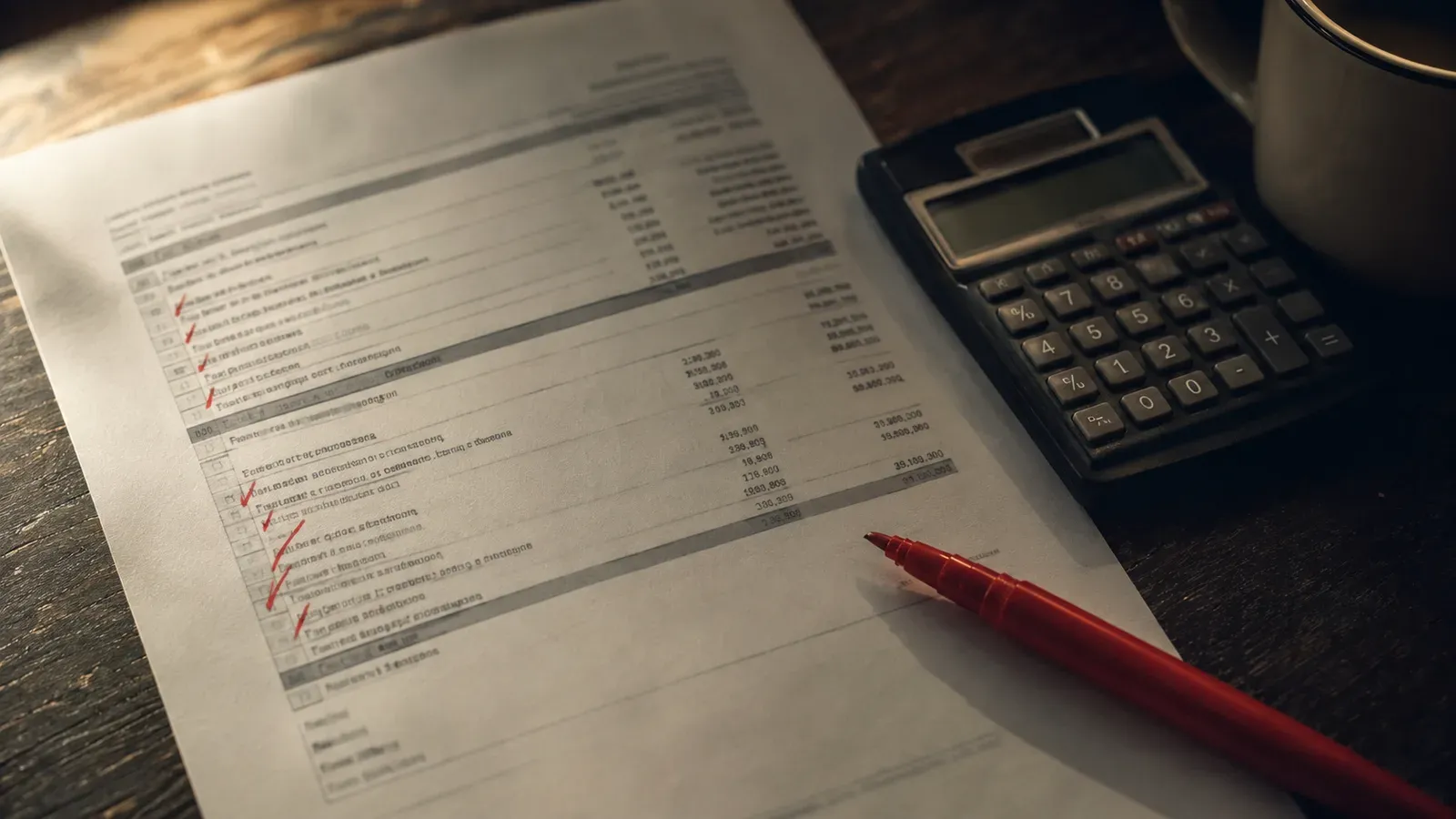
A carrier can deduct from a leased owner-operator's settlement only the items the lease itself clearly specifies. 49 CFR 376.12(h) requires the lease to name every item the carrier may pay for up front and later deduct from your compensation, so the test for any charge is whether you can point to it in your lease. Separately, 376.12(i) says you cannot be required to buy products, equipment, or services from the carrier as a condition of the lease.
A carrier can take the deductions your lease clearly specifies — and that’s the whole test. Under 49 CFR 376.12(h), the lease must “clearly specify all items that may be initially paid for by the authorized carrier, but ultimately deducted from the lessor’s compensation.”
So when a charge shows up on your settlement, there is exactly one question to ask: which section of my lease authorizes this? If you can point to it, it’s a charge-back the regulation contemplates. If nobody can point to it — not you, not dispatch, not the settlement clerk — the lease has not met what (h) requires.
The short version: Deductions aren’t legal because they’re common. They’re legal because they’re written in your lease. A named item, in a signed lease, deducted at the amount the lease describes. Everything else is a question you’re entitled to ask in writing.
Who does this apply to?
Leased owner-operators. Part 376 governs leases between an authorized motor carrier and the owner of equipment that carrier does not own. If you own or hold lawful possession of the truck and it runs on the carrier’s authority, you’re the lessor, and 376.12 is yours. Lease-purchase drivers are generally covered too.
Not company drivers. If you’re a W-2 employee driving the carrier’s truck, deductions from your paycheck are governed by your employment agreement and by federal and state wage law — not by 376.12(h). The rules on this page won’t help you there, and it’s better to know that up front than to file the wrong complaint.
If you’re not sure which side of that line you’re on, start with our plain-English walkthrough of truth in leasing and 49 CFR 376.12.
Which deductions are normal, and which ones deserve a hard question?
Almost nothing is categorically banned by 376.12 — the regulation’s mechanism is disclosure, not a list of forbidden charges. What it bans is charging you for things the lease never named. So the useful table isn’t “legal vs. illegal,” it’s “routinely proper vs. needs a lease citation.”
| Deduction | Ordinarily fine when… | Ask a hard question when… |
|---|---|---|
| Fuel advance | The lease names advances as a charge-back and the amount recovered matches what you drew. | The recovered amount exceeds the advance, or a per-advance fee appears that the lease never named. |
| Escrow contribution | The lease states the amount, what the fund may be spent on, and the accounting method, per 376.12(k). | There’s no stated cap, no permitted-use list, no interest ever posted, or the balance is unverifiable. |
| Occupational accident / physical damage insurance | The lease names it and you get the policy or certificate 376.12(j) requires. | You were told you must buy it through the carrier to lease on — see 376.12(i). |
| Trailer or equipment rental | Named in the lease at a stated rate. | The rate changes without a signed addendum. |
| Plates, permits, IFTA | Named in the lease; 376.12(e) requires the lease to specify who bears permit and tax costs. | Charged for a full year on a lease you left in month three, with no proration in the lease. |
| ELD / telematics subscription | Named in the lease at a stated monthly amount. | It appears mid-lease with no addendum, or you were required to buy the carrier’s device as a condition of leasing on. |
| Cargo claims / damage | The lease specifies claim responsibility and the deduction is documented with the actual claim. | A round number is deducted with no claim documentation, or the deduction precedes any claim resolution. |
| Overweight fines | 376.12(e) requires the lease to specify how overweight fines are allocated — and it does. | The lease is silent on overweight fines but you’re charged anyway. |
| Detention | The lease specifies detention treatment, which 376.12(e) calls for. | Detention pay is promised verbally and appears nowhere in the lease. |
| Tolls | 376.12(e) requires the lease to address toll cost responsibility. | You’re charged tolls the lease assigns to the carrier. |
| Chargebacks for “admin,” “processing,” “misc” | The lease names the fee and its amount. | It’s a vague catch-all line — this is the single most common unexplained deduction. |
The pattern is consistent: the regulation lets the carrier charge you for a great many things, provided it told you in advance, in the lease.
What does 376.12(e) require the lease to sort out?
Subsection (e) is the one drivers skip and then regret. It requires the lease to specify a set of practical items:
- Responsibility for identification device removal and return
- Receipt procedures
- Who bears costs: fuel, taxes, mileage, permits, tolls, and detention
- Loading and unloading responsibility
- Allocation of overweight fines
Two of those decide real money. Detention — if your lease doesn’t address it, you have no contractual hook when you sit six hours at a receiver. And overweight fines — a single ticket can run into hundreds of dollars, and (e) exists precisely because carriers and drivers used to fight over who ate it.
Read (e) before you sign, not after your first scale ticket.
Can my carrier require me to buy from them?
376.12(i) says the lease must specify that you are “not required to purchase or rent any products, equipment, or services from the authorized carrier as a condition” of entering into the lease.
This is the most under-used subsection in the whole section. It doesn’t ban the carrier from selling you insurance, fuel, plates, tires, or an ELD — plenty of carriers offer genuinely good group pricing, and buying in voluntarily can be the right call. What it addresses is the condition: being told that leasing on requires taking the carrier’s package.
The distinction is between “here’s our program, most guys take it, here’s the price” and “you can’t run here unless you’re on our program.” The second one is what (i) speaks to.
A worked example: auditing one settlement
Percentage lease, 70% of linehaul. Here’s the settlement as it arrived:
| Line | Amount |
|---|---|
| Linehaul (reported $2,400.00) | $1,680.00 |
| Fuel advance | −$420.00 |
| Advance fee (3 draws @ $8.00) | −$24.00 |
| Insurance | −$185.00 |
| Trailer rental | −$150.00 |
| ELD | −$25.00 |
| Plate & permit | −$60.00 |
| Escrow | −$50.00 |
| Admin fee | −$35.00 |
| Total deductions | −$949.00 |
| Net | $731.00 |
Now audit it against the lease.
Trace each line to a lease section. Fuel advance, insurance, trailer rental, ELD, plate & permit, and escrow are each named in the lease. Good — those are charge-backs (h) contemplates.
Two lines have no lease section. The $8.00-per-draw advance fee and the $35.00 admin fee appear nowhere in the lease. Not in the charge-back list, not in an addendum you signed. That’s $59.00 this week.
Now scale it. At four settlements a month: $59 × 52 weeks = $3,068 a year in charges that no lease section supports. That’s not a rounding error, and it’s exactly the kind of slow leak that never gets noticed on a week-by-week glance.
Then check the top line. You’re on percentage, so under 376.12(g) the lease must specify that the carrier gives you the rated freight bill before or at settlement. The bill arrives: the load billed at $2,750.00, not the $2,400.00 reported. Your 70% of the real figure is $1,925.00, not $1,680.00 — a $245.00 shortfall on the revenue side, on top of the $59.00 in unsupported deductions.
Total exposure on one settlement: $304.00. The deduction lines were the smaller problem. This is why auditing deductions without also verifying the linehaul catches only half of what’s wrong.
How do I audit my own settlements without an accountant?
Three months of statements and a spreadsheet is enough. Do it in this order.
1. Build a deduction matrix. Rows are settlement dates, columns are deduction categories. Enter every line. Patterns jump out immediately — a category that should be flat but drifts upward, a charge that appears every third week, a “misc” line that’s never the same number twice.
2. Map every column to a lease section. Write the section number in the column header. Any column you can’t map goes on the question list. This is your 376.12(h) check, and it’s the entire exercise in one step.
3. Total each column. A $12 weekly charge reads as noise. The same charge at $624 a year reads as a decision.
4. Verify the revenue side. Percentage pay? Match each settlement to its rated freight bill under (g). Mileage pay? Compare paid miles against your own logs and against the compensation term the lease states under (d).
5. Reconcile escrow separately. Deposits in, disbursements out, current balance, interest posted. 376.12(k) gives you the right to demand an accounting at any time, requires the carrier to pay interest at least quarterly at a rate based on 91-day Treasury bill yields, and requires return of the fund no later than 45 days from termination. Escrow is the account most likely to be quietly wrong; we cover it fully in getting your owner-operator escrow refunded.
6. Check the clock. Under 376.12(f) the lease must specify payment within 15 days after you submit the necessary delivery documents. Note your submission date against your pay date on every row. If the gap is drifting, that’s its own issue — see when carriers must pay owner-operators.
A statement that already itemizes each deduction with its source makes this a ten-minute job instead of an afternoon. That’s the design goal behind Fleetive’s settlement statements — every deduction line carries what it is and where it came from, rather than collapsing into a single net figure. For how settlements get assembled and reconciled generally, see our driver settlements guide.
What to do if a deduction doesn’t add up
Ask in writing, and name the subsection. Email creates a record; a hallway conversation doesn’t. Keep it short and factual:
“On my settlement dated [date] there is a $35.00 line labeled ‘admin fee’ and a $24.00 line for advance fees. Under 49 CFR 376.12(h), the lease is required to clearly specify all items that may be deducted from my compensation. Please identify the section of my lease that authorizes each of these charges. If they are authorized by an addendum, please send me the signed copy.”
Request the documents the lease already owes you. Rated freight bills under (g) if you’re on percentage. An escrow accounting under (k). Insurance policies or certificates under (j) — showing insurer name, policy number, effective dates, coverage amounts and types, costs, and deductibles — if you’re being charged for coverage bought through the carrier.
Don’t accept a verbal fix as the fix. If the carrier agrees the charge was wrong, get the correction on a settlement statement or in an email. Verbal corrections don’t survive turnover in the back office.
Escalate with the file, not the frustration. If it doesn’t get resolved:
- File with the FMCSA National Consumer Complaint Database. Per FMCSA’s complaint center FAQs, complaints help determine which companies the agency investigates and are kept in the company’s file. The assistance line is 1-888-DOT-SAFT (1-888-368-7238).
- Understand your court remedy. 49 U.S.C. § 14704 gives a person injured by a carrier’s violation of these regulations a private right of action for damages, and permits the court to award a reasonable attorney’s fee to the prevailing party. Courts have required proof of actual damages — which is precisely what your deduction matrix and your three months of statements are.
If you’re leaving, protect the final settlement first. Final settlements and escrow returns are where disputes concentrate, and the 45-day escrow clock in (k) runs from termination. What to do when a carrier holds your final settlement covers that sequence.
The bottom line
There’s no federal list of banned deductions, and anyone who tells you there is hasn’t read the section. What 376.12 does is far more useful: it makes the lease the authority. A deduction is legitimate because it was disclosed to you in writing before it was taken — named in the lease, at a described amount, with the accounting the regulation calls for.
Which means the leverage is entirely on your side of the desk, and it costs nothing to use it. Get your lease. Build the matrix. Map every column to a section. Ask about what doesn’t map, in writing, citing the subsection.
Most drivers who run that exercise find something. Usually not fraud — usually a fee that got added years ago and was never explained to anyone.
More owner-operator guides are in the Fleetive driver hub.
This article explains federal regulations in general terms and is not legal advice. Lease terms, state law, and individual circumstances vary — consult a qualified transportation attorney about your specific situation. Fleetive builds settlement and compliance software; it does not provide legal representation or guarantee any carrier’s regulatory compliance.
Note: This article is for general informational purposes and reflects regulations as of its publish date. It is not legal advice. Always confirm current requirements with the FMCSA and the eCFR, or your safety department.