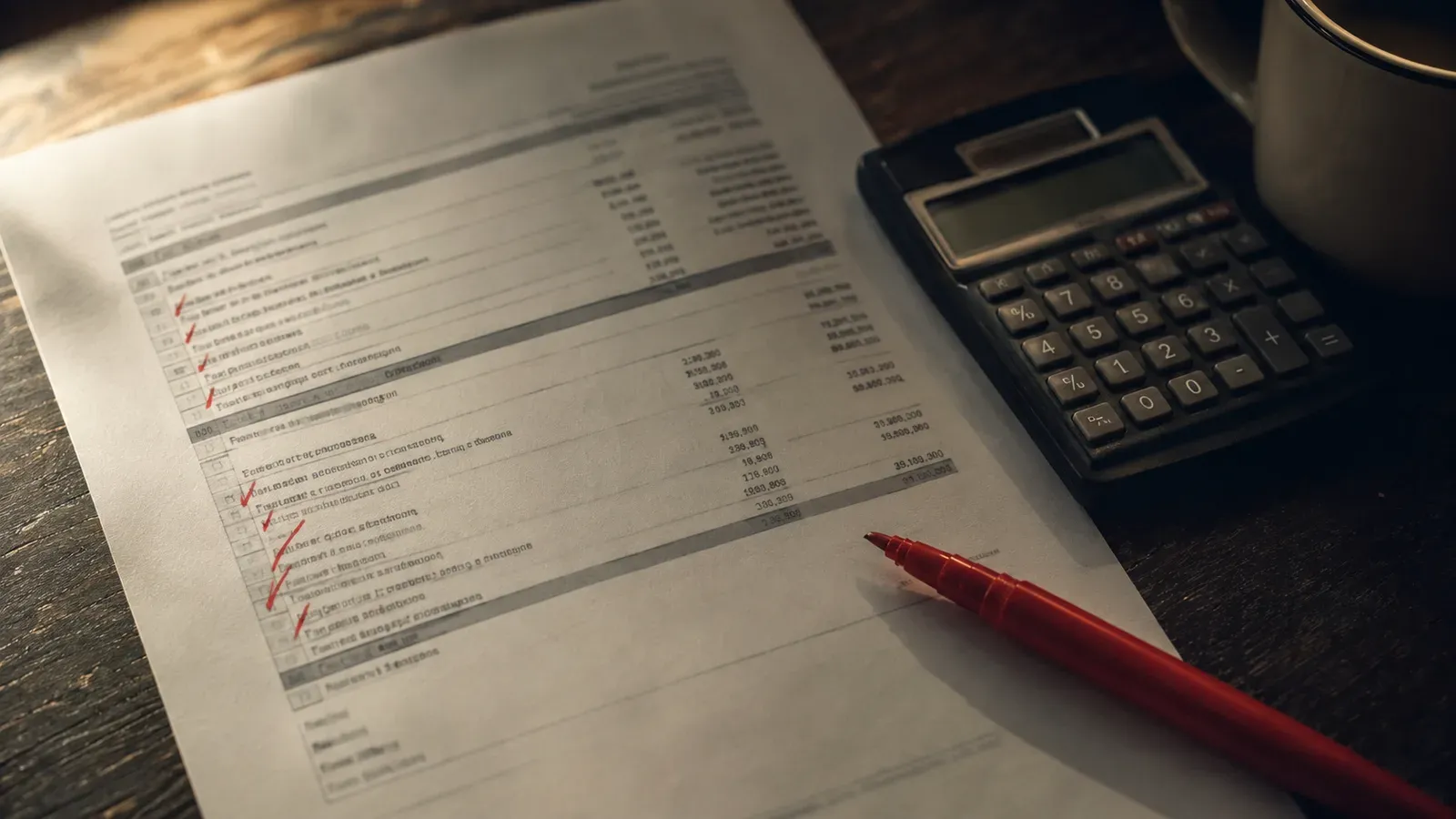

A carrier has 45 days from the date the lease terminates to return an owner-operator's escrow fund. That deadline comes from the federal truth-in-leasing rules at 49 CFR 376.12(k), which state that "in no event shall the escrow fund be returned later than 45 days from the date of termination." The clock runs from termination — not from when the carrier finishes its paperwork, and not from when it feels like cutting the check.
A carrier must return your escrow no later than 45 days after the lease terminates. That is not a courtesy or an industry norm — it is written into the federal truth-in-leasing rule that governs your lease, at 49 CFR 376.12(k), which requires the lease to state that “in no event shall the escrow fund be returned later than 45 days from the date of termination.”
If you searched for escrow and you were thinking about a home closing, this is not that page. This is about trucking escrow: money an authorized motor carrier holds back from a leased owner-operator’s settlements. Different money, different rules, different federal agency.
General information, not legal advice. Lease terms, termination dates, and state contract law vary. For a real dispute over real money, talk to a transportation attorney or to OOIDA before you sign anything or accept a partial payment.
What is escrow in trucking, and why does the carrier hold it?
When you lease your truck to an authorized carrier, it typically withholds money — often built up over your first several settlements — into what the regulations call an escrow fund. It is your money. The carrier is holding it, not earning it.
The purpose is security: if you run up a fuel card balance, damage a trailer, take a cargo claim, or leave with the carrier’s permits and plates, escrow covers it. That is legitimate, and escrow is legal. What is not legal is treating the fund as a slush account with no accounting, no interest, and no deadline for giving it back.
Escrow is one line in a much larger set of protections. Start with truth-in-leasing explained — escrow makes far more sense sitting next to the compensation and chargeback rules.
How long does a carrier have to return escrow?
45 days from the date of termination. The operative language, verbatim from 49 CFR 376.12(k):
“in no event shall the escrow fund be returned later than 45 days from the date of termination.”
Read the phrase “in no event.” That is a ceiling, not a target. It does not say 45 days after the carrier’s final audit, or after claims are resolved, or after the final settlement issues. It says 45 days from termination. Three consequences follow:
- Your lease cannot buy the carrier more time. A lease promising 60 or 90 days is out of step with the rule it is required to follow.
- A pending dispute does not pause the clock. If the carrier thinks you owe it money, the answer is to deduct an authorized item and account for it — not to sit on the whole fund while you argue.
- “We process escrow refunds quarterly” is a policy, not a rule. Policies do not outrank 376.12(k).
When does the 45-day clock actually start?
On the date of termination. This is where most escrow fights live, because “termination” is genuinely ambiguous if nobody wrote anything down. Was it the day you gave notice? The day you turned in plates, permits, and fuel card? The day the carrier dropped you from its insurance? A carrier with an incentive to delay will always pick the latest defensible date.
The fix is boring and effective: terminate in writing, and date it. An email titled “Notice of lease termination — Unit 214 — effective March 3, 2026” costs nothing and converts a future argument into a document. Keep the reply, the receipt for returned plates and permits, and a photo of the truck with the carrier’s markings removed.
| Milestone | What happens | What 49 CFR 376.12(k) requires |
|---|---|---|
| While you’re leased on | Carrier holds the escrow fund | The lease must specify the amount required and the items the fund applies to |
| Every settlement (or monthly) | Escrow transactions are accounted for | Itemized on individual settlement sheets, or a separate accounting provided monthly |
| Any time you ask | You request a full escrow accounting | You may demand an accounting at any time — no waiting period |
| At least quarterly | Interest is paid on the fund | At a rate based on the yield of 91-day Treasury bills |
| Day 0 — date of termination | The 45-day clock starts | Termination is the trigger, not final settlement |
| Day 45 after termination | Outer deadline to return the fund | ”In no event” later than this |
Worked example: $1,500 escrow, terminated March 3
You leased on 14 months ago. The carrier withheld $125 per settlement until your escrow fund reached $1,500, where it has sat since. You gave written notice and the lease terminated March 3, 2026. Count 45 days: 28 left in March, plus 17 into April.
April 17, 2026 is the outer deadline. On April 18 the carrier is late — regardless of whether your final settlement issued, whether a $400 cargo claim is still open, or whether the office is short-staffed.
Now suppose the carrier pays on April 15 but sends $1,100 with no explanation. You are entitled to an accounting of what came out and why, and any deduction has to trace to an item your lease authorizes. Ask for the $400 in writing, by line item, with supporting documents — see carrier settlement deductions for how to challenge a chargeback.
Also notice: 14 months means at least four quarters of interest should have been paid on that $1,500. If you cannot find a single interest line, that is its own question to raise.
What is the carrier actually required to put in the lease about escrow?
Under 376.12(k), the lease has to spell out all of the following. Check your lease against this list — the absences are usually more revealing than the language:
- The amount of escrow required.
- The specific items the escrow fund applies to.
- The accounting procedure — either each escrow transaction’s amount and description on your individual settlement sheets, or a separate accounting provided monthly.
- Your right to demand an accounting of the fund at any time.
- Interest paid at least quarterly, at a rate based on the yield of 91-day Treasury bills.
- Return of the fund no later than 45 days from the date of termination.
You are also entitled to the signed lease itself. Under 376.12(l), both parties sign, the carrier keeps a copy and places one on the equipment, and you keep one. If you were never handed your signed copy, ask for it first — every argument below is harder without it.
Does any of this apply if you’re a company driver?
No. This is the most common misunderstanding on the topic, and worth being blunt about.
49 CFR Part 376 governs the lease between an authorized carrier and an owner-operator who leases equipment to that carrier. It is a federal leasing regulation — not a wage-and-hour law, not a state labor code, and it does not reach W-2 company-driver payroll.
If you are a company driver and your employer is sitting on a security deposit, a “damage deposit,” a final paycheck, or a withheld bonus, FMCSA is not your remedy. Your remedy is your state labor department’s wage-payment rules, which set their own deadlines for final pay and often carry real teeth. Look up your state’s wage claim process and file there.
The dividing line is not what the carrier calls you — it is the actual lease. Leased your equipment to an authorized carrier? Part 376 is in play. Drive the company’s truck for wages? It is not.
Your carrier blew the 45-day deadline. Here’s the escalation path.
Work these in order. Each step is cheap and builds the record for the next, and most disputes end before the bottom of the list.
1. Assemble the file first. One folder: the signed lease, your termination notice and any reply, every settlement statement showing an escrow withholding, every escrow accounting the carrier sent, proof you returned plates and permits, and a running total of what the fund should hold. Screenshot anything living only in a carrier portal — that access disappears fast after you leave.
2. Send a dated written demand. Email plus certified mail, short and unemotional, with five things: the termination date, the 45-day deadline that ran from it, the citation (49 CFR 376.12(k)), the exact amount owed, and a date by which you expect payment or a written accounting. Ask explicitly for an itemized accounting of any deduction. A demand that quotes the regulation is treated very differently from a phone call.
3. Call OOIDA. The Owner-Operator Independent Drivers Association has spent decades on leasing disputes and knows how they play out with specific carriers.
4. File a complaint with FMCSA. Commercial leasing complaints go through the National Consumer Complaint Database at nccdb.fmcsa.dot.gov. Know what it is: a federal record against the carrier’s DOT number that can inform enforcement attention, not a collections service. File it anyway — a pattern of complaints against one carrier is what regulators look for.
5. Talk to a transportation attorney. For a fund of any real size, one consultation is usually worth it. Ask whether small claims court is the faster path — for $1,500, it often is.
Do not accept a partial payment described as “final” without understanding what you are giving up, and be careful signing a carrier-drafted release while money is in dispute. If the carrier is also sitting on your last settlement, see what to do when a carrier holds your final settlement.
How to protect your escrow before you ever need to terminate
The best time to deal with an escrow dispute is about a year before it happens.
- Read the escrow clause before you sign. Check it against the six-item list above. The absences tell you how the rest of the relationship will run.
- Track the balance yourself. A running spreadsheet of every withholding, deduction, and interest payment takes two minutes a week and settles most arguments.
- Use the accounting right. Once a year, in writing, tells you whether the carrier’s records match yours while you still have leverage.
- Watch for interest. At least quarterly. Its absence is often the first sign the fund isn’t administered as the regulation requires.
- Never terminate verbally. One dated email beats six months of good intentions.
Carriers with clean, itemized settlement records rarely end up in these fights, because the escrow balance sits on the statement every week where both sides can see it — a workflow problem as much as a compliance one, and what a purpose-built driver settlement system is for. If you produce settlements rather than receive them, the driver settlements guide covers what a defensible statement has to show.
Frequently asked questions
How long does a carrier have to return escrow to an owner-operator? 45 days. Under 49 CFR 376.12(k), the lease between a leased owner-operator and an authorized carrier must state that in no event shall the escrow fund be returned later than 45 days from the date of termination. A lease promising a longer window does not override the regulation.
When does the 45-day escrow clock start? On the date of termination — not your last delivery, not your final settlement, and not the day the carrier finishes reconciling your account. If you and the carrier disagree about the termination date, that disagreement is usually the whole dispute, which is why dated written notice matters so much.
Does the carrier have to pay interest on my escrow? Yes, if you are a leased owner-operator covered by 49 CFR 376.12(k). The lease must specify that the carrier pays interest on the escrow fund on at least a quarterly basis, at a rate based on the yield of 91-day Treasury bills. If you have never seen an interest line, put that question to the carrier in writing.
Can a carrier take deductions out of my escrow before returning it? Only for items the lease authorizes. 376.12(k) requires the lease to specify the items the escrow fund applies to, and 376.12(h) requires it to clearly specify every item that may be deducted from your compensation. A charge that is not in your lease is worth disputing, and you can demand an accounting of the fund at any time.
I’m a company driver. Does the 45-day escrow rule apply to me? No. Part 376 governs the lease between an authorized carrier and an owner-operator who leases equipment to that carrier. It is not a wage law and does not cover W-2 payroll, final paychecks, or employer-held deposits. Company drivers should go to their state labor department’s wage-payment rules, not FMCSA.
What should I do if the carrier misses the 45-day deadline? Send a dated written demand stating the termination date, the deadline, the amount owed, and a response date. If that fails, escalate: OOIDA, a complaint through FMCSA’s National Consumer Complaint Database, and a transportation attorney. Keep every settlement statement and escrow accounting — documentation is what turns a complaint into a claim.
Is trucking escrow the same as mortgage escrow? No, and search results mix them up constantly. Mortgage escrow is an account your loan servicer uses to pay property taxes and homeowners insurance. Trucking escrow is money a motor carrier withholds from a leased owner-operator’s settlements to secure performance and cover authorized charges, governed by 49 CFR 376.12(k).
The short version
45 days from termination, triggered by a dated termination notice, with an itemized accounting of anything deducted and quarterly interest along the way. That is what your lease is required to promise, and the standard to hold the carrier to.
Escrow is only one deadline the leasing rules impose. The other is how fast you get paid in the first place — 15 days after you submit the necessary delivery documents, a narrower promise than most owner-operators realize. Read when carriers must pay owner-operators next, and browse the driver and owner-operator library for the rest.
Note: This article is for general informational purposes and reflects regulations as of its publish date. It is not legal advice. Always confirm current requirements with the FMCSA and the eCFR, or your safety department.